Blog: What Is Kubernetes? A Beginner’s Guide for Businesses in 2026
Cloud & DevOpsWhat Is Kubernetes? A Beginner’s Guide for Businesses in 2026
In this guide
- Simple explanation for beginners
- Why it matters for modern businesses
- How Kubernetes actually works
- Kubernetes on AWS, Azure & GCP
- Key benefits for businesses
- When should your business use it?
- Common challenges
- Kubernetes vs traditional deployment
- Getting started — beginner steps
If you’ve been hearing the word “Kubernetes” a lot in tech conversations but aren’t quite sure what it means for your business — you’re not alone. This guide explains Kubernetes in plain English, without the heavy jargon. Whether you’re a startup founder, a CTO evaluating cloud options, or someone just beginning their DevOps journey, this is the guide for you. And if you’re already thinking about modernising your infrastructure, partnering with a reliable cloud architecture consulting India team can make the transition far smoother.
What Is Kubernetes? (Simple Explanation for Beginners)
Kubernetes — often written as K8s — is an open-source platform that helps you manage your software applications at scale. Think of it as a smart operations manager for your software.
Here’s a relatable analogy: imagine you run a restaurant chain with 50 outlets. You need someone to make sure every outlet is staffed, orders are being handled, and if one outlet runs short — backup arrives automatically. Kubernetes does exactly that, but for your software applications running on servers.
More technically, Kubernetes is a container orchestration platform. “Containers” are lightweight packages that hold your application and everything it needs to run. “Orchestration” means managing how and where those containers run across many servers — automatically, efficiently, and without manual intervention.
Container orchestration with Kubernetes means your apps are always running, automatically scaled, and self-healing — even if individual servers fail.
Why Kubernetes Is Important for Modern Businesses
The way businesses build and deliver software has changed dramatically. Users expect apps to be fast, always available, and capable of handling sudden traffic spikes. Kubernetes helps businesses meet these expectations reliably.
- Application scaling: During peak traffic — like a sale or product launch — Kubernetes automatically spins up more instances of your app to handle the load.
- Reliability: If a part of your application crashes, Kubernetes detects it and restarts it automatically, often before users even notice.
- Faster deployments: New features and bug fixes can be rolled out without downtime, keeping your customers happy and your team moving quickly.
- Cost efficiency: Kubernetes ensures your servers are used optimally — not over-provisioned or sitting idle, which directly reduces cloud bills.
How Kubernetes Works (Without Technical Complexity)
You don’t need to understand every detail under the hood, but knowing the key concepts will help you make informed decisions.
Containers and Pods
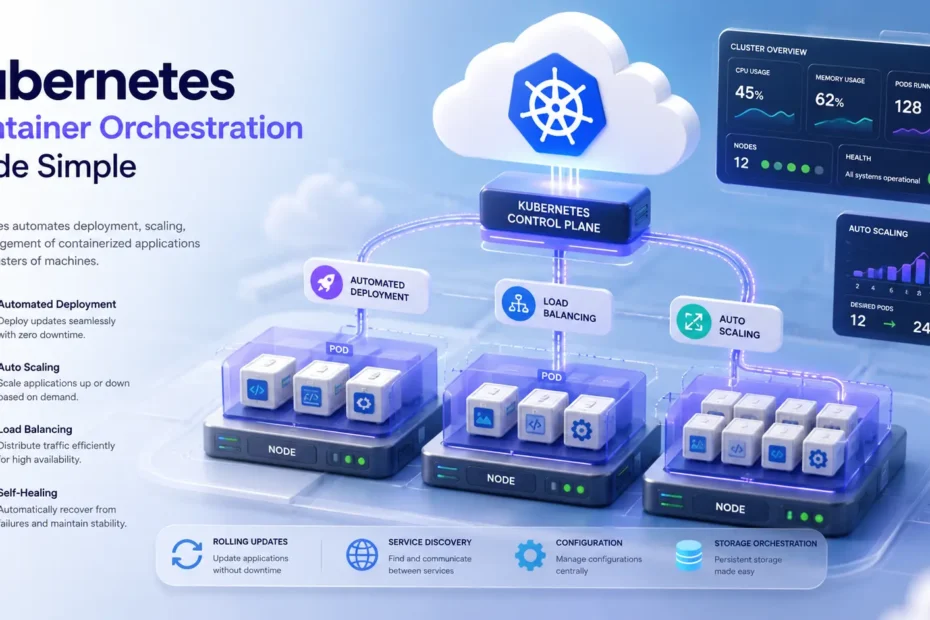
A container is a self-contained unit of your software — think of it like a sealed box that includes your app and all its dependencies. In Kubernetes, containers are grouped into Pods, which are the smallest deployable units. A pod might contain one container or a few tightly related ones working together.
Nodes and Clusters
A Node is simply a server (physical or virtual) where your pods run. A collection of these nodes forms a Cluster. Your Kubernetes cluster is the entire fleet of servers Kubernetes manages for you. One cluster can run dozens of applications simultaneously.
Control Plane and Scheduling
The Control Plane is the brain of Kubernetes. It watches over your cluster, makes decisions about where to run pods, handles failures, and ensures your application always matches the desired state you’ve defined. The Scheduler within the control plane decides which node each pod should run on — based on available resources and your rules.
Properly architecting these components from the start is critical. Working with an experienced cloud architecture consulting India team ensures your Kubernetes setup is designed for your specific workload and growth plans.
Kubernetes on Cloud: AWS, Azure & Google Cloud
One of the biggest advantages of Kubernetes today is that all major cloud providers offer a managed version of it, so you don’t have to set it up from scratch:
- AWS: Amazon Elastic Kubernetes Service (EKS)
- Azure: Azure Kubernetes Service (AKS)
- Google Cloud: Google Kubernetes Engine (GKE) — the most mature, since Google originally created Kubernetes
These managed services handle the heavy lifting — provisioning, upgrades, security patches — so your team can focus on building products instead of managing infrastructure.
If you’re currently running workloads on traditional servers or an older cloud setup, leveraging cloud migration services India can help you transition to a Kubernetes-based architecture without disrupting your existing operations.
Key Benefits of Kubernetes for Businesses
- Scalability: Automatically scale up during high demand and scale down when traffic drops — no manual effort needed.
- High availability: Built-in redundancy means your app keeps running even when individual components fail.
- Efficient resource usage: Kubernetes packs workloads onto servers intelligently, reducing wasted compute and lowering costs.
- Faster development cycles: Teams can deploy code updates multiple times a day, enabling faster iteration and quicker time-to-market.
- Portability: Applications running on Kubernetes can move between cloud providers or on-premises infrastructure with minimal friction.
For growing businesses, opting for managed Kubernetes services India is often the smartest path — you get all the benefits of Kubernetes without needing a large in-house DevOps team to maintain it.
When Should a Business Use Kubernetes?
Kubernetes is powerful, but it’s not the right tool for every situation. Here’s when it starts to make real sense:
- Growing applications: If your user base is expanding and your app needs to handle increasing traffic reliably, Kubernetes gives you the scalability foundation to grow confidently.
- Microservices architecture: If you’ve broken your application into smaller, independent services (microservices), Kubernetes is the ideal platform to manage them all consistently.
- Frequent deployments: Teams shipping features and fixes multiple times a week benefit enormously from Kubernetes-powered continuous delivery pipelines.
Not sure if your architecture is ready for Kubernetes? A good DevOps consulting services India partner can assess your current setup and recommend whether Kubernetes is the right next step — or if there’s a simpler path forward.
Common Challenges with Kubernetes Adoption
Kubernetes is powerful, but it comes with a real learning curve. Being aware of the challenges upfront helps you plan better.
- Complexity: Kubernetes introduces new concepts, tooling, and abstractions. For smaller teams without prior experience, the initial setup can feel overwhelming.
- Learning curve: Developers and operations teams need time to understand how Kubernetes works — training and documentation investment is necessary.
- Misconfiguration risks: Incorrect configurations can lead to security gaps, resource waste, or application failures. Best practices and guardrails are essential from day one.
The good news: managed Kubernetes services and experienced consulting partners significantly reduce these risks, especially for businesses adopting Kubernetes for the first time.
Kubernetes vs Traditional Deployment (Simple Comparison)
- Manual server management
- Scaling requires human intervention
- Downtime during updates
- Servers often over-provisioned
- Failures need manual recovery
- Automated container management
- Auto-scaling based on real demand
- Zero-downtime rolling updates
- Optimal resource utilisation
- Self-healing — restarts automatically
The operational difference is significant. Traditional deployments require your team to respond to every failure and scaling event manually. Kubernetes handles most of that automatically, freeing your team to focus on building, not firefighting.
Getting Started with Kubernetes (Beginner Steps)
If you’re convinced Kubernetes is worth exploring, here’s a practical way to begin without overwhelming your team:
- Start small: Don’t migrate your entire infrastructure on day one. Begin with a single non-critical application to learn the ropes with lower risk.
- Use managed services: Start with EKS, AKS, or GKE so you’re not managing the underlying infrastructure yourself. Let the cloud provider handle upgrades and availability.
- Invest in training: Make sure at least one or two team members have foundational Kubernetes knowledge. Free resources like the official Kubernetes docs and KubeAcademy are a great start.
- Monitor performance early: Set up monitoring tools like Prometheus and Grafana from the beginning — you need visibility into what’s happening inside your cluster.
- Engage the right expertise: Partner with a specialist in cloud architecture consulting India to review your design before you scale. A good architecture review upfront saves significant time and cost later.
Conclusion
Kubernetes has become the de facto standard for running modern cloud-native applications — and for good reason. It solves real problems around scalability, reliability, and operational efficiency that growing businesses face every day.
That said, Kubernetes is not a silver bullet. It introduces complexity and requires proper planning to implement well. For a small app with a stable user base and a tiny team, the overhead may outweigh the benefits. The key question isn’t “should we use Kubernetes?” but rather “does Kubernetes fit our current scale and growth trajectory?”
Before diving in, evaluate your architecture, your team’s readiness, and your business goals. The right use-case alignment makes all the difference between Kubernetes being a competitive advantage — or an unnecessary burden.
Is Kubernetes right for your business?
Before adopting Kubernetes, it’s worth evaluating whether your architecture, team size, and workload complexity justify the investment. Speaking with a cloud and DevOps specialist can help you make a confident, informed decision — without overcomplicating things unnecessarily.